Scroll all you want. Just come out smarter.
June 30, 2026 · 7 min read
The scroll isn’t the problem. What it ends in is. We kept the pull and changed the payoff.
Let's be honest about scrolling: it feels good. The smooth swipe, the endless supply, the tiny anticipation before each new thing loads — it's one of the most refined interaction loops ever built, and it's refined because thousands of very smart people spent years and fortunes refining it. Telling people to simply stop is like telling water to flow uphill.
So maybe the goal shouldn't be to stop. Maybe it should be to keep the loop and change what it ends in.
The scroll isn't the enemy
The mechanics of the feed — the swipe, the "just one more," the effortless forward motion — are neutral. They're a delivery system. The reason doomscrolling leaves you hollow isn't the scrolling; it's the payload. You're being delivered an unbroken stream of things optimized to be almost satisfying, so you keep reaching for the next one, and the session only ends when you run out of will, not when you're done.
Notice what a session of that scrolling produces: nothing. No artifact, no answer, no idea you didn't have an hour ago. You performed a lot of motion and ended exactly where you started, minus the time.
What a "like" actually is
The like button is the quiet tell. In a social feed, the terminal action — the thing that closes the loop on a piece of content — is a reaction aimed at the author. You tap it, a number goes up somewhere, and you move on. The gesture records that you saw something and had a feeling about it. It records nothing about whether you understood it, learned from it, or will remember it tomorrow.
It can't, because in that world there's nothing to understand. The content wasn't built to teach you; it was built to earn the tap. The like is the perfect terminal action for a feed whose real product is your attention: frictionless, public, and completely empty of learning.
Ending in understanding instead
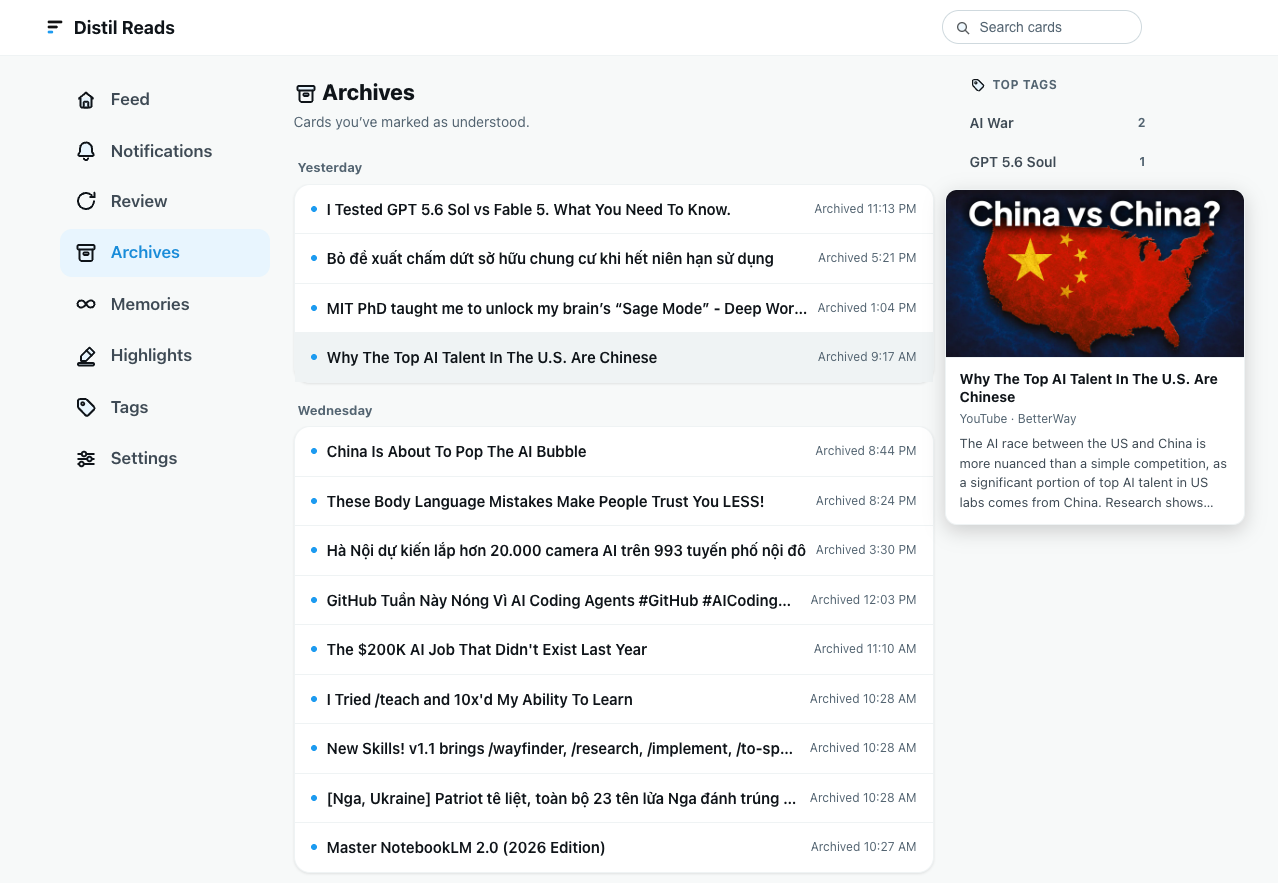
Distil Reads keeps the scroll and rips out the like. The feed still moves like the ones you know — you swipe through Cards, you feel the same pull to continue — but when you finish a card, the closing action isn't aimed at an author. It's aimed at yourself, and it's about comprehension.
You tell the card the truth. Understood archives it — you got it, it can leave the feed. Not Quite admits you read it but it didn't fully land. There's no audience for either answer; it's a private note-to-self about the state of your own knowledge. The feed answers to what you comprehended, not to what you tapped.
The loop that teaches: spaced return
Here's where the honest answer pays off. When you mark a card Not Quite, it doesn't just disappear — it comes back, later, on a spaced schedule that stretches each time you see it again (a day, then a few days, then a week, then longer). This is spaced repetition, the most robust learning technique psychology has, and it only works because you were willing to admit the card hadn't stuck yet.
So the scroll becomes a genuine learning loop. The things you understood clear out. The things you didn't quietly return, spaced further apart each time, until they do. The feed isn't measuring your engagement; it's tracking your comprehension and actively working to improve it.
Same pull, different person at the end
The point was never to make scrolling feel virtuous or turn reading into homework. The pull is the feature — it's what gets you to open the app when willpower is low, which is exactly when a better feed would help most. Distil Reads just redirects that pull. You scroll for the same reasons, with the same ease, for the same slightly-too-long stretch. You simply come out the other side sharper instead of emptier — a stack of things understood, a few marked to return, and not a single like to your name.