The Eisenhower Matrix, for your reading list
June 25, 2026 · 7 min read
Urgent and important are not the same word. A 70-year-old decision tool fixes your someday-pile.
Dwight Eisenhower — Supreme Allied Commander, then two-term US president — is supposed to have said, "I have two kinds of problems, the urgent and the important. The urgent are not important, and the important are never urgent." He almost certainly borrowed the line, but the distinction it draws has outlived him because it names something we get wrong every single day.
We treat urgent and important as the same word. They are not. And nowhere does the confusion cost more than in what we choose to read.
Two words we keep collapsing
Urgent means it demands attention now: it's loud, it has a deadline, it's blinking. Important means it actually matters to your goals: it moves something, it compounds, you'd regret skipping it.
Most things are one but not the other. A notification is urgent, not important. A book that would change how you think is important, but it's never urgent — nothing bad happens today if you skip it, which is exactly why you skip it today, and tomorrow, and forever. Urgency hijacks attention. Importance has to be chosen, deliberately, or it silently loses to whatever's making noise.
The four boxes
The Eisenhower Matrix draws the two axes and gives you four quadrants:
- Urgent + Important — crises, real deadlines. Do these now.
- Not Urgent + Important — the deep work, the learning, the compounding stuff. Schedule these, protect them, or they evaporate.
- Urgent + Not Important — interruptions dressed as priorities. Minimize.
- Not Urgent + Not Important — noise. Delete.
The famous insight is that quadrant two — important but not urgent — is where all the value lives, and it's the one that constantly gets starved, because it never raises its hand.
Your reading list is quadrant two
Look at what you save to read later. Almost all of it is quadrant two: important, never urgent. The talk that would sharpen how you think. The long explainer on the thing you keep pretending to understand. None of it has a deadline. None of it blinks. So it loses — every day — to the group chat, the notification, the feed that manufactures fake urgency by the second.
A generic bookmark folder makes this worse, because it flattens everything to one undifferentiated list. The genuinely important read sits at the same visual weight as the thing you saved on a whim, and with no signal of what matters, you default to whatever's newest or on top. Urgency wins again, this time by accident.
Priority, built into the capture
Distil Reads bakes the matrix into the moment you save something. When you Capture a source, you tag it with a Priority drawn straight from Eisenhower's quadrants — urgent, important, both, or neither. It's one tap, and it costs you nothing, but it records a judgment you'd otherwise never make explicit.
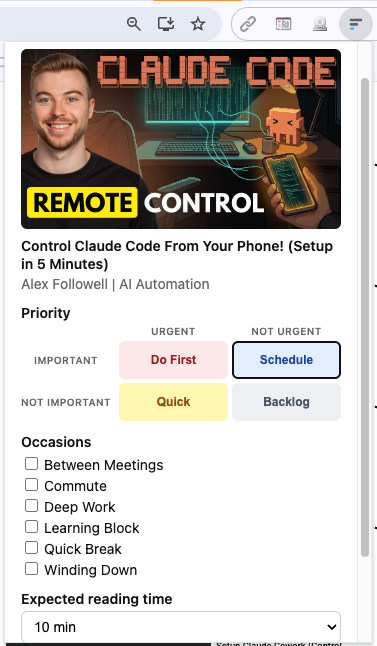
Then your feed uses it. Cards don't surface by recency or by whatever an algorithm thinks will hold you — they lead with what you marked important. The quadrant-two reading that would normally lose to noise gets structurally promoted to the top of your attention, because you told the system, at save time, that it mattered.
Choosing importance on purpose
The whole trick of the Eisenhower Matrix is that it forces a choice that importance can't win on its own. Left to default, urgency always takes the day. Made explicit — sorted, tagged, ordered — importance finally gets a fighting chance.
Applied to reading, that's the difference between a someday-pile that quietly mocks you and a feed that reliably puts the most valuable thing you saved in front of you first. Same list. One judgment, made once, at capture. Eisenhower would approve.